By Mamuda, Wakili,
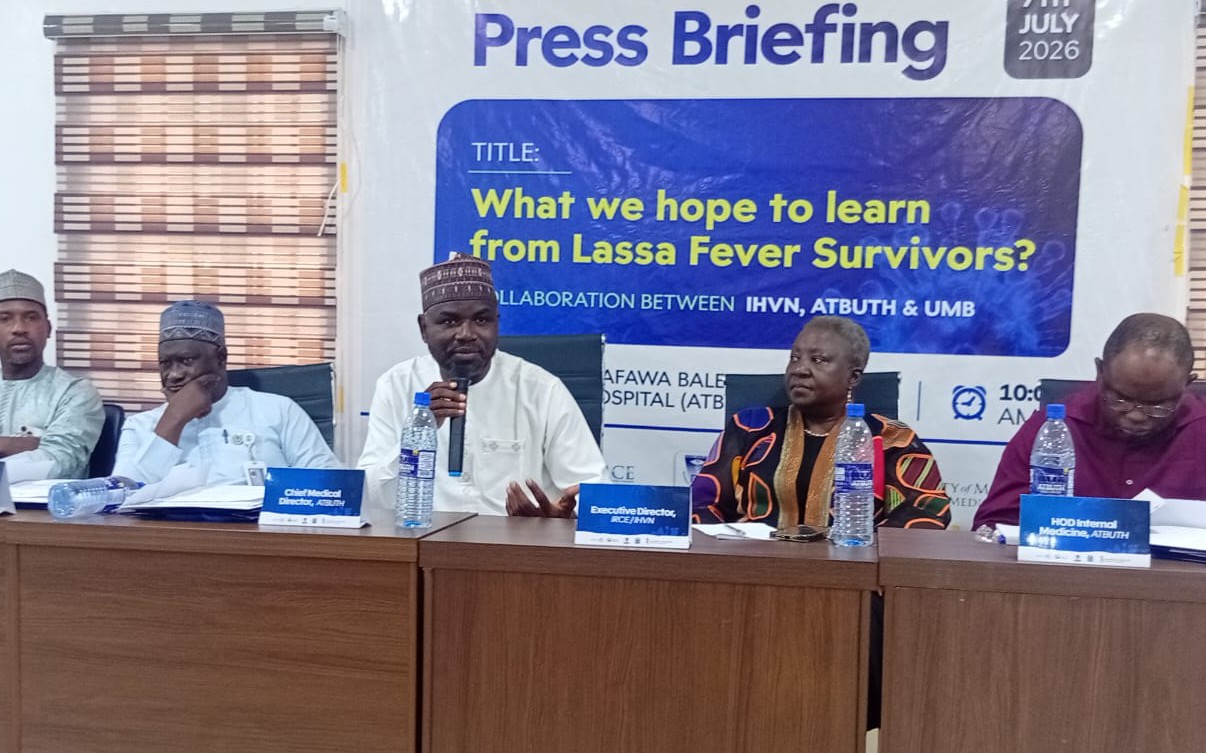
BAUCHI — The Institute of Human Virology Nigeria (IHVN), through its International Research Center of Excellence (IRCE), in collaboration with Abubakar Tafawa Balewa University Teaching Hospital (ATBUTH), has launched a research study on Lassa fever survivors.
The study, titled “Identification and Immunologic Characterization of Adult Lassa Fever Survivors in Nigeria,” aims to advance efforts to develop an effective vaccine against Lassa fever and strengthen disease surveillance in northern Nigeria.
It is being implemented in partnership with the Center for Vaccine Development and Global Health (CVD) at the University of Maryland School of Medicine.
Speaking during a press briefing on Tuesday at ATBUTH, Nigerian Principal Investigator and Executive Director of IHVN, Professor Alash’le Abimiku, said the collaboration will focus on identifying the five different strains of the Lassa virus circulating in the region.
“This is to ensure that future vaccines are effective against the variants affecting local populations,” Abimiku said.
She said the research will also study Lassa fever survivors to understand the immune responses that enabled them to recover. The findings, she added, will provide valuable insights for the development of a safe and effective vaccine.
Abimiku noted that although treatments exist to manage Lassa fever, there is currently no approved cure or widely available vaccine, making research and prevention critical.
“This study reflects IHVN’s enduring commitment to advancing health through science, strengthening in-country research capacity, and ensuring that African populations are active participants in and beneficiaries of the knowledge generated through research,” she said.
Abimiku also stressed the importance of community engagement in reducing exposure to rats, the primary carriers of the virus. She urged residents to seek medical attention promptly whenever symptoms appear, noting that early treatment significantly improves survival.
“This study represents an important step forward in our collective efforts to work with communities to reduce behaviors and exposures that increase the risk of Lassa virus infection. By studying Lassa fever survivors in Nigeria, we are generating locally grounded evidence that will directly inform vaccine development and ultimately save lives,” Abimiku said.
She further explained: “Despite being endemic in West Africa for several decades with high case fatality rates, critical gaps remain in our understanding of how natural infection confers immunity in those that survive, and how vaccine development can benefit from such knowledge. This 12-month collaborative study will seek to generate deeper insight into natural immunity following infection. The data generated will serve as a critical reference point for ongoing and future Lassa fever vaccine trials.”
“This study will also work with communities to minimize known risk factors and establish a repository of clinical data and biological samples a valuable long-term scientific resource for the research community,” she added.
Abimiku said the work will leverage ATBUTH’s and IHVN’s existing world-class laboratory infrastructure. This includes IHVN’s ISO 15189:2022 accredited laboratory in Jos, Plateau State (PLAVIREC), the Institute’s regional biorepository facility (I-HAB) in Abuja, and ATBUTH’s Molecular Genetics and Infectious Disease Research Laboratory.
She called for continuous training of healthcare workers to improve early detection and diagnosis of Lassa fever, especially in patients with multiple infections such as malaria.
Abimiku added that the partnership brings together IHVN and local health institutions, with plans to expand the research network to other northern states, including Gombe and Taraba, to strengthen the region’s response to Lassa fever.
In his remarks, the Chief Medical Director of ATBUTH, Professor Jibrin Bara Yusuf, highlighted the importance of the study for communities in Bauchi that have experienced a surge in Lassa fever cases.
“A Lassa fever vaccine is even more relevant and important now, and we as a teaching hospital for the state will continue to partner to make this a reality for our people,” Yusuf said.
He said the partnership is at the heart of the hospital’s mandate in research, training, capacity building, professional development, and succession planning.
“Our institution is committed to working closely with national and international partners to strengthen healthcare, education, and scientific research. We are especially pleased to be collaborating with our counterparts in Nigeria, as we believe such partnerships create opportunities for knowledge sharing, innovation, and mutual growth,” he said.
“Our organization has a strong academic and research base, with highly qualified professionals, including more than 80 PhD holders, who contribute significantly to research, training, and certification programmes. Through this collaboration, we hope to build stronger institutional relationships, enhance skills development, and promote joint research initiatives,” Yusuf added.
“Bauchi State has the clinical and laboratory infrastructure to contribute to knowledge that will lead to prevention and treatment of Lassa fever. We are excited to collaborate with colleagues in Nigeria and contribute to global efforts to develop effective vaccines against Lassa fever.
In addition, my institution has a long-term relationship with communities to ensure that knowledge on how to prevent Lassa fever transmission is sustained in each community and that health workers recognize clinical symptoms of Lassa for prompt intervention,” he concluded.